
Asking for Sugar Next Door
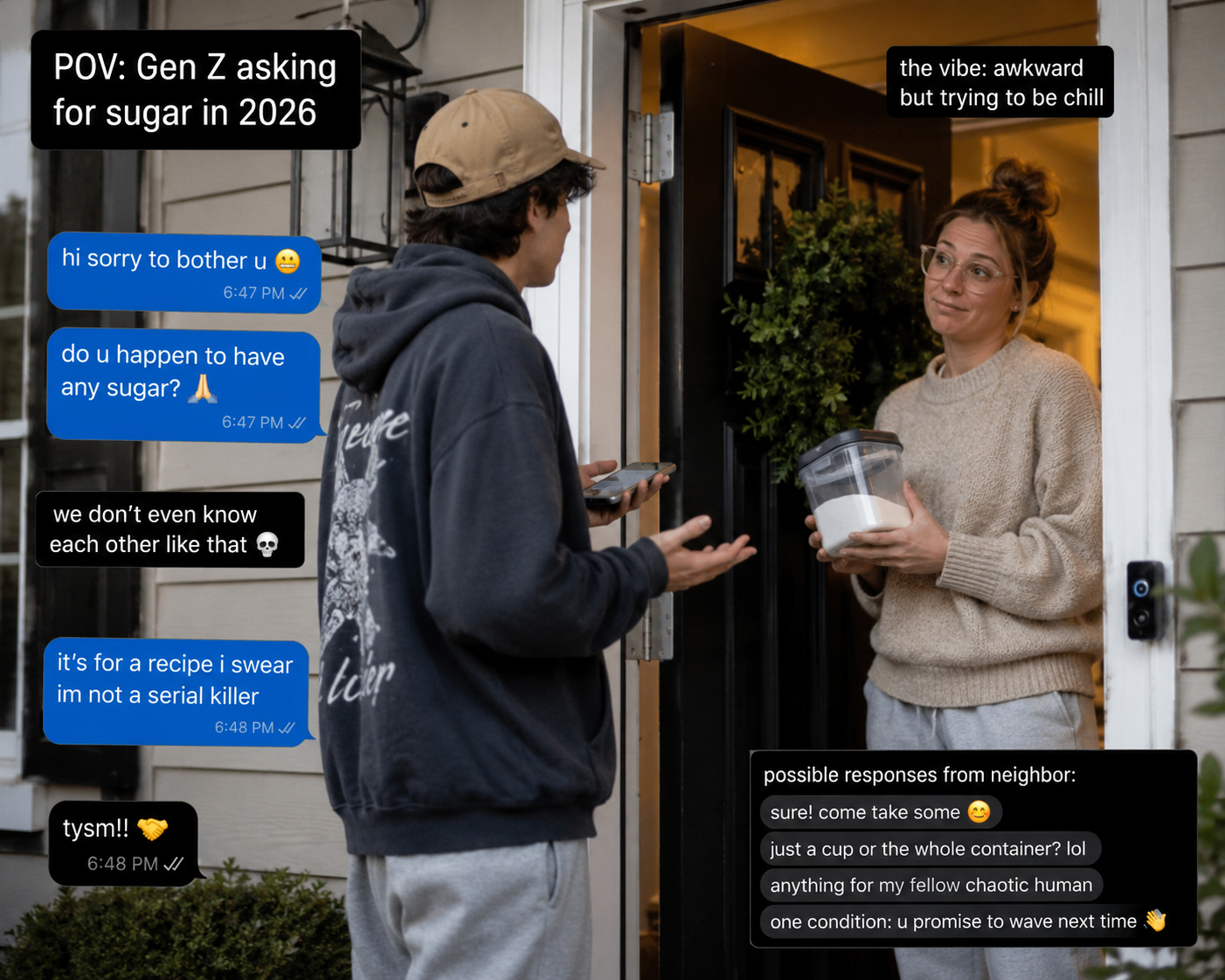
I remember my Mom running out of sugar while baking. She'd just send me next door to borrow some. In today's world of instant delivery, that feels almost quaint.
There is growing concern about deteriorating interpersonal skills. The digital world hasn't invented weak social skills -- however it's changed the environments where they get practiced. Daily life has shifted toward individualized media, remote work, and smartphones, and many ordinary forms of social training simply stopped being automatic.
The challenge is that most digital systems are optimized for efficiency, personalization, and the avoidance of friction. Becoming more human often means deliberately reintroducing what technology removes.
Start small. Most interpersonal skills are built in tiny moments. Make eye contact with the cashier. Ask one follow-up question. Learn a neighbor's name. Say good morning first. These micro-interactions train emotional calibration, warmth, and the ability to read subtle cues.
Listen without optimizing. Digital culture rewards fast responses and performing intelligence. In person, people mainly want attention, emotional recognition, and curiosity. Let pauses happen. Reflect before you solve. "That sounds frustrating -- what part has been hardest?" changes how people experience you more than any clever answer will.
Tolerate awkwardness. Digital systems let us edit, delete, and retreat instantly. Human closeness usually requires staying present through small imperfections -- silence, misunderstanding, imperfect wording. That discomfort is where growth actually lives.
Create shared experiences. A lot of digital interaction is purely informational: links, opinions, updates. Human bonding tends to grow from shared activity -- cooking together, walking, helping someone move. Historically, humans bonded while doing, not just talking.
Protect attention. Meals without phones. Walks without headphones. Conversations without multitasking. Attention is one of the clearest signals of care that humans recognize.
And one more thing that might sound old-fashioned: talk to the person next to you on the plane, train, or bus. Not to intrude - just to acknowledge their presence. We may never see them again, but there is something fundamentally human in that simple act of contact.
The digital world can simulate information. It cannot simulate mutual vulnerability. That remains entirely human territory.
Think Big, Start Small, Act Now,
- Lorne
P.S. I'm grateful for a couple of stimulating conversations with my seatmates during the long flights to and from Boston this past week. Often, I never say a word to someone sitting next to me on a five-hour flight. This time, I intentionally changed that. The interactions made me smile and reminded me how much people and their stories are the most interesting novels.
Garrett's View: There's something wrong with the idea that we'd rather Instacart an ingredient than bother our neighbors to borrow some. Instead, be the neighbor who considers buying extra to lend and offers in advance. We don't want to lose that. In 2024, Forbes reported more than 50 percent of Gen Z say their in-person social skills have declined. It's easier said than done, and we have to force the fix. Only 58 percent of Gen Z consider going out to third places an important part of how they socialize -- their idea of a fun night is increasingly food delivery, video games, and streaming at home. We're all a little too old to be grounded, so why are we doing this to ourselves?
AI Response: The data backs Lorne up. Between 2019 and 2024, one behavioral medicine center recorded a 908% increase in Gen Z individuals seeking treatment for social anxiety. Young adults have gone from being among the happiest age group to the least happy -- a complete reversal of a decades-old pattern. Even the bar visit is fading: the share of adults under 35 who drink has dropped from 72% in 2001 to 62% in 2023, and in 1991, 64% of high school seniors had been drunk at least once -- by 2024, just 33%. Meanwhile, 86.5% of phone use during meals involves social networking and texting. The sugar next door isn't just quaint -- it was load-bearing infrastructure for how humans stayed sane.
Search Blog Posts:
Categories
Month
- October 2026
- September 2026
- August 2026
- July 2026
- June 2026
- May 2026
- April 2026
- March 2026
- February 2026
- January 2026
- December 2025
- November 2025
- October 2025
- September 2025
- August 2025
- July 2025
- June 2025
- May 2025
- April 2025
- March 2025
- February 2025
- January 2025
- December 2024
- November 2024
- October 2024
- September 2024
- August 2024
- July 2024
- June 2024
- May 2024
- April 2024
- March 2024
- February 2024
- January 2024
- December 2023
- November 2023
- October 2023
- September 2023
- August 2023
- July 2023
- June 2023
- May 2023
- April 2023
- March 2023
- February 2023
- January 2023
- December 2022
- November 2022
- October 2022
- September 2022
- August 2022
- July 2022
- June 2022
- May 2022
- April 2022
- March 2022
- February 2022
- January 2022
- December 2021
- November 2021
- October 2021
- September 2021
- August 2021
- July 2021
- June 2021
- May 2021
- April 2021
- March 2021
- February 2021
- January 2021
- December 2020
- November 2020
- October 2020
- September 2020
- August 2020
- July 2020
- June 2020
- May 2020
- April 2020
- March 2020
- February 2020
- January 2020
- December 2019
- November 2019
- October 2019
- September 2019