
The Thucydides Trap Inside the Organization
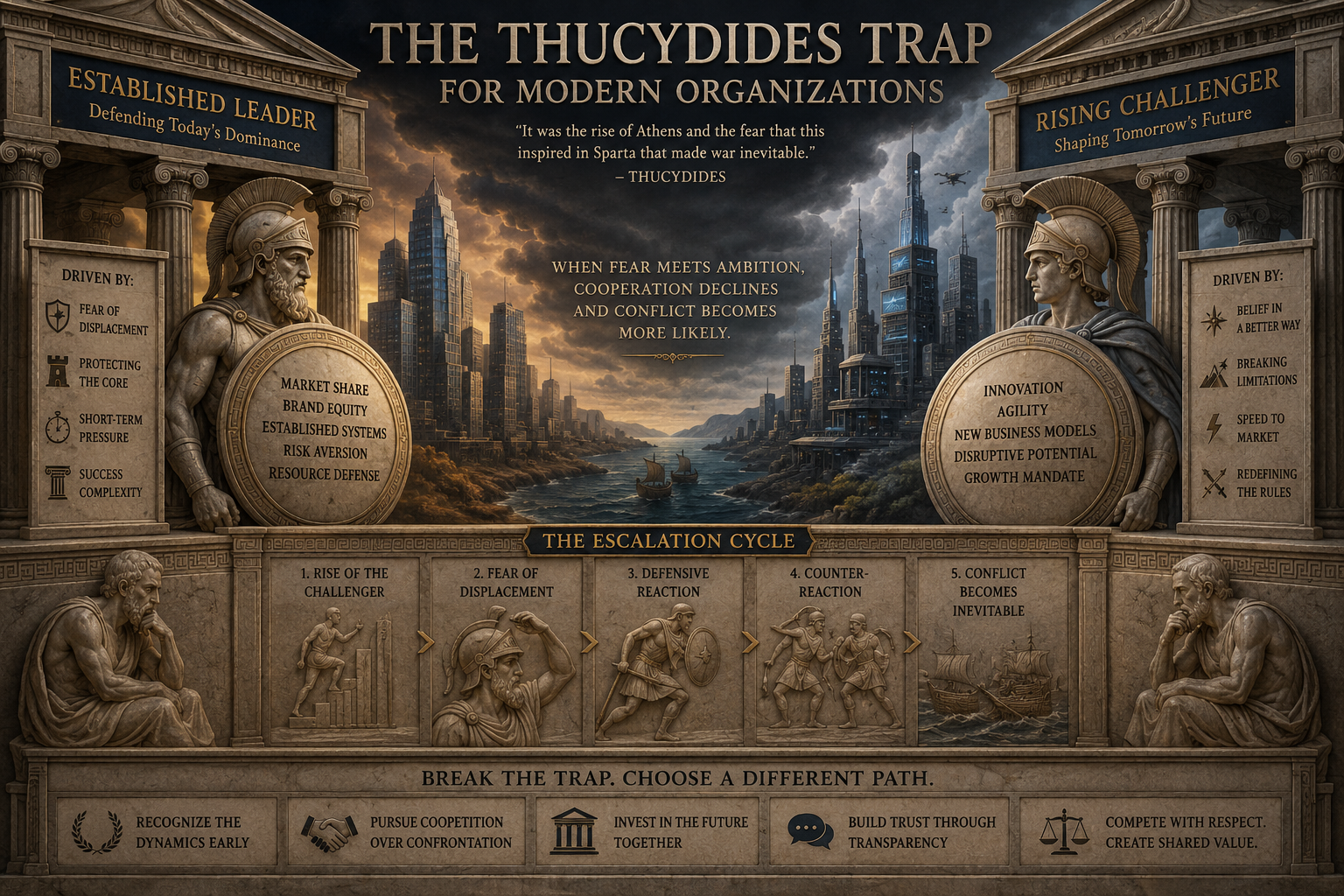
President Xi once asked whether China and the US could navigate forward without falling into the Thucydides Trap. The ancient Greek historian Thucydides observed that the rise of Athens created fear in Sparta that made conflict nearly impossible to avoid.
Organizations are not nation states, yet the underlying human dynamic transfers with remarkable precision.
Most organizational resistance is not about logic. It is about perceived displacement.
After decades of watching transformations succeed, stall, and quietly implode, I have come to believe that leaders consistently misread what is actually happening beneath the surface. We tell ourselves: if people just understood the strategy, saw the data, or appreciated the urgency, they would get on board. So we invest in communication campaigns, town halls, and change management frameworks. Meanwhile, the real conflict is somewhere else entirely.
A digital unit gains influence. AI reshapes decision-making. A younger cohort challenges long-standing assumptions. On paper, these shifts are framed as progress. Emotionally and politically, many established leaders experience something different: erosion. Not of title, not immediately of compensation, but of relevance. And relevance, inside organizations, is among the most fiercely protected forms of currency.
The gap between what leadership says and what people hear is where transformations die.
Leadership says: "We are evolving." Others hear: "What made you valuable before matters less now."
Leadership says: "We need agility." Others hear: "The old sources of authority are disappearing."
Leadership says: "We are becoming data-driven." Others hear: "Experience and intuition are losing standing."
Once uncertainty enters the system, defensive behaviors multiply. Meetings become performative. Information becomes guarded. Coalitions form quietly. Public alignment masks private resistance. And critically, the more aggressively change leaders push, the more threatened incumbents feel., and the more aggressively they protect territory. Both sides believe they are acting defensively. That is the trap.
I have seen organizations spend millions on transformation initiatives while paying almost no attention to the social transition occurring simultaneously. The spreadsheet becomes the strategy. The org chart becomes the intervention. Technology becomes the symbol of progress. The emotional architecture of the organization is ignored entirely.
People can adapt to enormous operational change if they do not experience unnecessary identity destruction along the way. The goal of transformation should never be the humiliation of the old guard, nor the preservation of obsolete structures. The real leadership challenge is helping people move from one source of value to another without stripping away dignity in the process.
This is not softness. It is strategic realism.
Because once people conclude the future has no meaningful place for them, resistance stops being procedural and becomes existential. And existential resistance is extraordinarily difficult to manage.
The strongest transformation leaders honor institutional memory while building new capability. They avoid framing change as a morality play between innovators and dinosaurs. They understand that preserving contribution is often more important than preserving hierarchy.
Organizations are not machines. They are living status systems. Every transformation reshapes who matters, who decides, and whose future expands or contracts. When leaders ignore that reality, even brilliant strategies collapse under the weight of invisible political gravity.
The danger is rarely in the change itself. The danger is unmanaged fear during transitions of power.
Garrett’s View: I think we all love being as logical as possible, but it’s a humbling 2,500 year old reminder from Thucydides that fear and honor are still primary decision drivers. We can update the technology, but our wiring remains the same.
- Garrett
AI Response: The numbers back Lorne up in a pretty uncomfortable way. BCG and McKinsey research consistently shows 70% of digital transformation initiatives fail to meet their objectives — and Bain's 2024 analysis puts it even higher, with 88% of business transformations falling short of their original ambitions. Meanwhile, 80 to 90% of transformation budgets flow into technology — exactly the spreadsheet-as-strategy pattern Lorne describes. The behavioral science side is equally compelling: Thucydides was essentially documenting what we now call status threat, and modern research confirms that perceived loss of relevance activates the same neurological fear response as physical danger. We've had 2,500 years to logic our way out of it. The data suggests we haven't made much progress.
Search Blog Posts:
Categories
Month
- September 2026
- August 2026
- July 2026
- June 2026
- May 2026
- April 2026
- March 2026
- February 2026
- January 2026
- December 2025
- November 2025
- October 2025
- September 2025
- August 2025
- July 2025
- June 2025
- May 2025
- April 2025
- March 2025
- February 2025
- January 2025
- December 2024
- November 2024
- October 2024
- September 2024
- August 2024
- July 2024
- June 2024
- May 2024
- April 2024
- March 2024
- February 2024
- January 2024
- December 2023
- November 2023
- October 2023
- September 2023
- August 2023
- July 2023
- June 2023
- May 2023
- April 2023
- March 2023
- February 2023
- January 2023
- December 2022
- November 2022
- October 2022
- September 2022
- August 2022
- July 2022
- June 2022
- May 2022
- April 2022
- March 2022
- February 2022
- January 2022
- December 2021
- November 2021
- October 2021
- September 2021
- August 2021
- July 2021
- June 2021
- May 2021
- April 2021
- March 2021
- February 2021
- January 2021
- December 2020
- November 2020
- October 2020
- September 2020
- August 2020
- July 2020
- June 2020
- May 2020
- April 2020
- March 2020
- February 2020
- January 2020
- December 2019
- November 2019
- October 2019
- September 2019