
Blue Dot Fever at Work
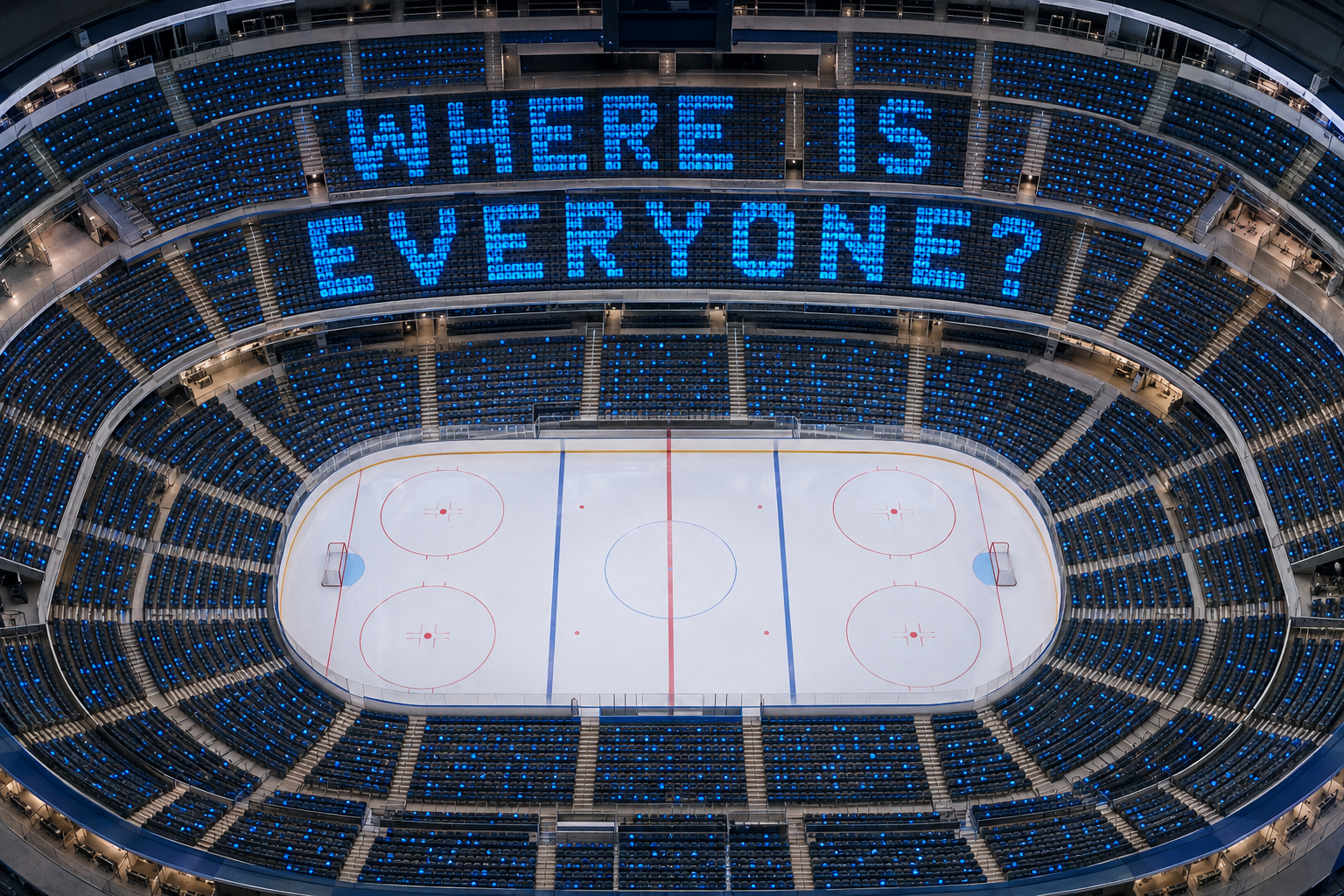
A sea of blue
I was listening to an NHL podcast recently where the hosts kept coming back to empty seats. Not just in smaller markets, but at Madison Square Garden and other arenas with big populations and fiercely loyal fans. Something is going on.
Open almost any ticketing site this year and you'll see it. Rows of little blue dots, each one an unsold seat. The industry has a name for it, Blue Dot Fever, and in 2026 it has humbled some very big names.
Post Malone postponed stadium dates. Meghan Trainor cancelled a tour amid a sea of blue dots. Zayn Malik scaled back his run. When promoters see a blue-covered map 48 hours before showtime, they start slashing prices to fill the room.
Fans still love the game and the music. They've just stopped buying the seat.
The price of the average seat
A typical concert ticket cost about $75 in 2016. Today it averages close to $150. NFL games now average more than $200 a seat and NBA games more than $90. My beloved Edmonton Oilers charge about $250 CAD for a decent seat.
Then come the concessions. A beer at SoFi Stadium in Los Angeles is $16. The hot dog is another $9.
The Fan Cost Index prices a family outing as four average tickets, two beers, two soft drinks, four hot dogs and one parking spot. For the NFL in 2025, that came to roughly US$1,340 for a single game. Now multiply by a season. That is the conversation happening at a lot of kitchen tables.
The suite shrugs, the upper bowl stays home
Here's what few people in the industry like to say out loud. At the top end, nobody blinks. As one Pollstar writer observed, people complain about prices, but for the top acts they still pay. The corporate box is a business expense. The VIP package still sells.
The squeeze is in the middle. These are the people who've held the same two seats in section 214 for fifteen years. They are not angry. They are doing arithmetic.
And the alternative has never been better. A big screen, every replay, the best angles, a fridge ten steps away, no parking, no lineup for the washroom. Staying home is no longer a sacrifice. It's the rational choice.
So they stay home. Quietly. No protest. No letter to the owner. Just one more blue dot where they used to sit.
The blue dots at work
A blue dot on a seating map is visible. A blue dot in an organization is not.
At work, the seat is filled. The badge swipes. The camera is on. The person has simply left in every way that matters. The workplace version of Blue Dot Fever is less about not showing up and far more about quitting on the job.
Gallup's State of the Global Workplace 2026 report puts numbers to it. Only 20 percent of employees worldwide are engaged, the lowest level since 2020, and the second straight year of decline. Another 64 percent are not engaged and 16 percent are actively disengaged. The estimated cost is about $10 trillion in lost productivity.
Read that as a seating map. Four out of five seats are blue.
The employee is running the same equation as the fan. What does it cost me to show up fully, and what do I get back? On one side sit the commute, the mandates, the meetings, the anxiety about AI and the time away from home. On the other sit meaning, growth, respect, belonging and a manager who knows my name. When the cost keeps rising and the experience does not, people choose the home theatre version of work. Present, polite and holding back their best.
Two more numbers should worry every executive team. Manager engagement fell from 27 percent to 22 percent in a single year, so the ushers are checking out too. And Gallup finds senior leaders report higher engagement than everyone else. From the suite, the stadium always looks full.
Reading your own seating map
The venues still filling seats are not simply cutting prices. They right-size the room, design the experience around the regular fan and give people a reason to be there in person. Leaders can do the same.
Walk the upper level. Skip-level conversations and frontline visits tell you what the dashboard will not. You cannot see blue dots from the suite.
Know your season ticket holders. Long-tenured, steady people who never complain are often the first to quietly stop renewing.
Fix the concessions. The extra approval, the pointless meeting and the system that never works are the $16 beer of organizational life.
Connect before content. People renew when they feel they belong to something, not when they are handed another initiative.
Invest in the ushers. In Gallup's best-practice organizations, 79 percent of managers are engaged. That is nearly four times the global average, and it is not an accident.
Final whistle
Blue Dot Fever is not a fan problem. It's a value problem. Fans have not stopped loving the experience. They have stopped believing the price matches the effort. Most employees have not stopped caring about their work either. They've stopped believing the experience is worth their best.
The good news is that a blue dot is not a lost fan. It's an empty seat waiting for a better reason.
So, how many blue dots are on your map? And would you even know, looking down from the suite?
How can I tell if my team is quietly disengaged, and what can I do about it as a leader?
Think Big, Start Small, Act Now,
Lorne
Garrett’s View: It’s almost as if we’ve gone from that fear of missing out (FOMO), to complete indifference. My algorithm is constantly reminding me how much healthier it is to be boring (prioritize sleep, limit alcohol, eat the same whole foods, be financially responsible, love your friends and family, get off social media, get outside and put your phone away). There’s no arguing with any of it. However! That also makes you an unapologetic, big blue dot. So the challenge for anyone selling a seat, whether it's in an arena or on an org chart, is to make me feel like I'm missing out again.
- Garrett
AI Response: The data behind Lorne's argument holds up and adds some sting. Gallup's 2026 report finds that lower engagement among managers accounts for most of the recent downturn, with manager engagement declining from 31% in 2022 to 22% in 2025, while non-managers dipped only slightly from 20% to 19%. The ushers really are where the seats are emptying. The scale is large too: Gallup notes each percentage point of engagement represents roughly 21 million employees, and the estimated $10 trillion in lost productivity equals about 9% of global GDP. The emotional cost is high as well. Globally, 40% of workers report daily stress and 22% report daily loneliness. On the concert side, the venues that avoided the fever back up Lorne's "fix the concessions" advice: Olivia Dean, Pearl Jam, and Bad Bunny have recently enjoyed sold-out shows, in part because they refused to inflate ticket prices, suggesting one cure for Blue Dot Fever may simply be fair pricing.
Search Blog Posts:
Categories
Month
- October 2026
- September 2026
- August 2026
- July 2026
- June 2026
- May 2026
- April 2026
- March 2026
- February 2026
- January 2026
- December 2025
- November 2025
- October 2025
- September 2025
- August 2025
- July 2025
- June 2025
- May 2025
- April 2025
- March 2025
- February 2025
- January 2025
- December 2024
- November 2024
- October 2024
- September 2024
- August 2024
- July 2024
- June 2024
- May 2024
- April 2024
- March 2024
- February 2024
- January 2024
- December 2023
- November 2023
- October 2023
- September 2023
- August 2023
- July 2023
- June 2023
- May 2023
- April 2023
- March 2023
- February 2023
- January 2023
- December 2022
- November 2022
- October 2022
- September 2022
- August 2022
- July 2022
- June 2022
- May 2022
- April 2022
- March 2022
- February 2022
- January 2022
- December 2021
- November 2021
- October 2021
- September 2021
- August 2021
- July 2021
- June 2021
- May 2021
- April 2021
- March 2021
- February 2021
- January 2021
- December 2020
- November 2020
- October 2020
- September 2020
- August 2020
- July 2020
- June 2020
- May 2020
- April 2020
- March 2020
- February 2020
- January 2020
- December 2019
- November 2019
- October 2019
- September 2019