
The Courage of Kindness
Have you watched the movie White Bird?
Helen Mirren plays Sara, a grandmother who sits with her grandson Julian after he has been expelled from school for bullying a classmate. Julian is starting over at a new school, and he already feels the pull of the cool kids, whose currency is cruelty. He wants to belong. He isn't sure yet what belonging should cost him.
So Sara tells him her story. As a young Jewish girl in 1940s occupied France, she was hidden from the Gestapo by a classmate she had barely noticed. He was a boy whose mobility had been ravaged by polio, and the other children mocked him for it. He and his family risked their lives to protect her.
Of course, most of us will never face anything close to that. Nobody in your next meeting is risking their life. Calling a tough conversation at work "courageous" can sound overblown, and "kindness" can sound more like a greeting card than a leadership strategy.
However, that is exactly the point. Families have risked everything to protect someone most of their peers ignored. So what is our excuse for avoiding an uncomfortable fifteen minutes? The stakes at work are smaller, and that should make the right choice easier, not harder. Still, we dodge it all the time.
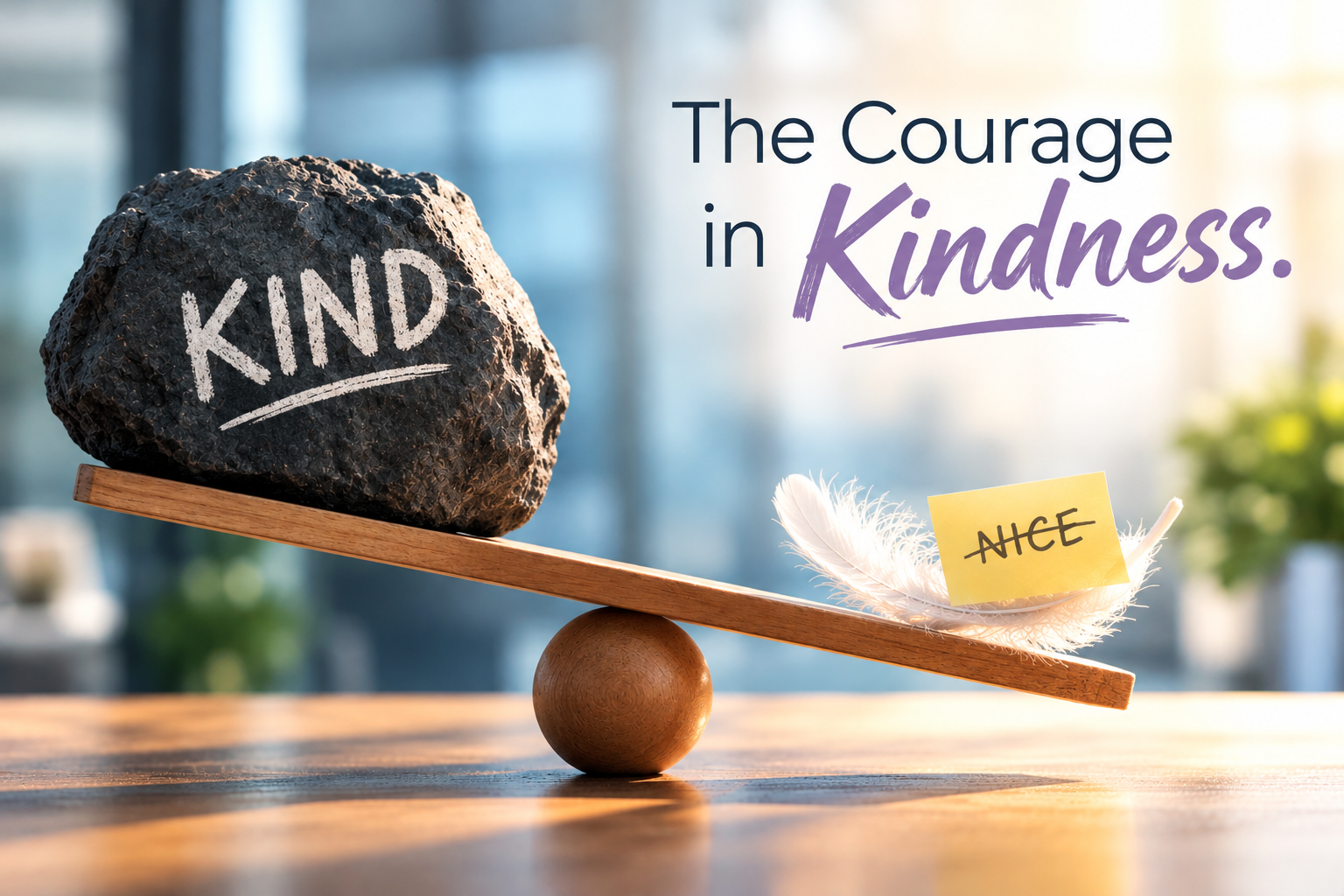
Kind is not the same as nice.
Part of the problem is that we confuse kindness with niceness. Nice is about keeping things pleasant. Kind is about acting in someone's real interest, even when it costs you comfort, popularity or time.
Nice tells a struggling team member "it's fine." Kind tells them the truth and helps them fix it. Nice stays quiet when a colleague is being talked about unfairly. Kind says something. Nice is easy. Kind usually costs something, which is why it's rarer.
Care and clarity belong together.
Throughout my career, I have watched the most effective leaders learn to hold two things at once:
They lead with genuine care, compassion and kindness.
They pair it with directness and clarity.
Care without clarity becomes indulgence. People feel liked but not led. Standards drift, difficult conversations get postponed, and the very people we say we care about are denied the honest feedback they need to grow.
Clarity without care becomes coercion. People comply, but they do not commit. They protect themselves rather than contribute.
The most admirable leaders refuse that trade-off. They tell you the truth because they care about where you are now and where you could go. That isn't soft. It takes self-awareness, discipline and a willingness to be uncomfortable.
Bullies are not strong.
Some leaders use their power to belittle others and to create fear and division. In the short term it can look like strength. Decisions get made quickly, dissent goes quiet, and the scoreboard may even look good for a quarter or two.
Fear is a terrible operating system. It shrinks the thinking of everyone in the room to a single question: how do I stay safe? People stop raising problems, offering ideas and telling the truth upward. Talent leaves quietly, or worse, stays and disengages.
Over time the bully is exposed. It usually isn't because someone heroically calls them out. It happens because the damage becomes impossible to hide. Turnover, broken teams, stalled innovation and wrecked reputations are the receipts.
Belittling others is not a sign of power. It is weakness looking for cover.
What people are asking for.
When we listen to employees, they ask for leaders who act as real coaches and teachers. (In 2026 alone, I have been part of two major leadership listening initiatives in large organizations.) They want leaders who are kind, caring and compassionate, and who invest in their growth and wellbeing.
This is not a request for leaders who avoid hard things. It's the opposite. People want someone who believes in them enough to hold them to a high standard, and who will stand beside them while they reach it.
This sits at the heart of the Character Triangle: being Self-Accountable, Respectful and Abundant. Kindness without accountability is incomplete. Accountability without respect is corrosive. And abundance, the belief that there is enough success to go around, is what frees a leader to lift others rather than compete with them.
The long arc.
The long arc of human experience bends toward something better. Over time, people seek respect, abundance and accountability. The family that hid Sara did not make headlines. They made life possible. That is the kind of legacy that endures.
A challenge for this week
Julian's dilemma is the one every leader faces: what will I trade to belong, and to whom do I really want to belong? An organization is different from a high school, but the underlying human dynamics follow a similar pattern.
None of this requires heroics. It requires noticing the moment and not looking away. So here is my challenge. Find one moment this week where the easy choice is to stay silent, go along with the room, or win by making someone else smaller. Choose kind over nice instead. Have the honest conversation, with care. Defend the person who is not in the room. Invest an hour in someone's growth.
The risk will feel bigger than it is. The cost of staying quiet is bigger than it looks.
Think Big, Start Small, Act Now,
Lorne
Garrett's View: I'll admit I can be a skeptic on both of these words. Kindness is frequently fraudulent, and I tend to save "courage" for situations where someone could actually get physically hurt. A hard conversation in a conference room doesn't qualify. Yet, what speaks to me is the person you want beside you is the one who will tell you the truth because they actually care what happens to you. That's who you want in your foxhole. And if that's what leadership looks like when everything is on the line, it's worth practicing when nothing is.
– Garrett
AI Response: Research backs up Lorne's case that care and performance go together. In a study by Jack Zenger and Joseph Folkman of more than 51,000 leaders, only 27 were rated both in the bottom quarter for likability and the top quarter for effectiveness. That's roughly a 1-in-2,000 chance of being disliked and effective at the same time. On the cost of belittling behavior, Christine Porath and Christine Pearson surveyed workers who had been treated rudely on the job. 48% deliberately decreased their work effort, 66% said their performance declined, 78% said their commitment to the organization dropped, and 12% left their jobs. Google's Project Aristotle found that psychological safety, meaning people feeling safe to speak up without being punished or humiliated, was the strongest predictor of team effectiveness. This lines up with Lorne's point that fear is a terrible operating system. Finally, Gallup estimates that managers account for at least 70% of the variance in team engagement, and global engagement fell to just 21% in its 2025 State of the Global Workplace report. That gap is exactly why employees are asking for leaders who coach rather than command.
Search Blog Posts:
Categories
Month
- October 2026
- September 2026
- August 2026
- July 2026
- June 2026
- May 2026
- April 2026
- March 2026
- February 2026
- January 2026
- December 2025
- November 2025
- October 2025
- September 2025
- August 2025
- July 2025
- June 2025
- May 2025
- April 2025
- March 2025
- February 2025
- January 2025
- December 2024
- November 2024
- October 2024
- September 2024
- August 2024
- July 2024
- June 2024
- May 2024
- April 2024
- March 2024
- February 2024
- January 2024
- December 2023
- November 2023
- October 2023
- September 2023
- August 2023
- July 2023
- June 2023
- May 2023
- April 2023
- March 2023
- February 2023
- January 2023
- December 2022
- November 2022
- October 2022
- September 2022
- August 2022
- July 2022
- June 2022
- May 2022
- April 2022
- March 2022
- February 2022
- January 2022
- December 2021
- November 2021
- October 2021
- September 2021
- August 2021
- July 2021
- June 2021
- May 2021
- April 2021
- March 2021
- February 2021
- January 2021
- December 2020
- November 2020
- October 2020
- September 2020
- August 2020
- July 2020
- June 2020
- May 2020
- April 2020
- March 2020
- February 2020
- January 2020
- December 2019
- November 2019
- October 2019
- September 2019