
Berated at the Dinner Table - What Would You Do?
The Dilemma
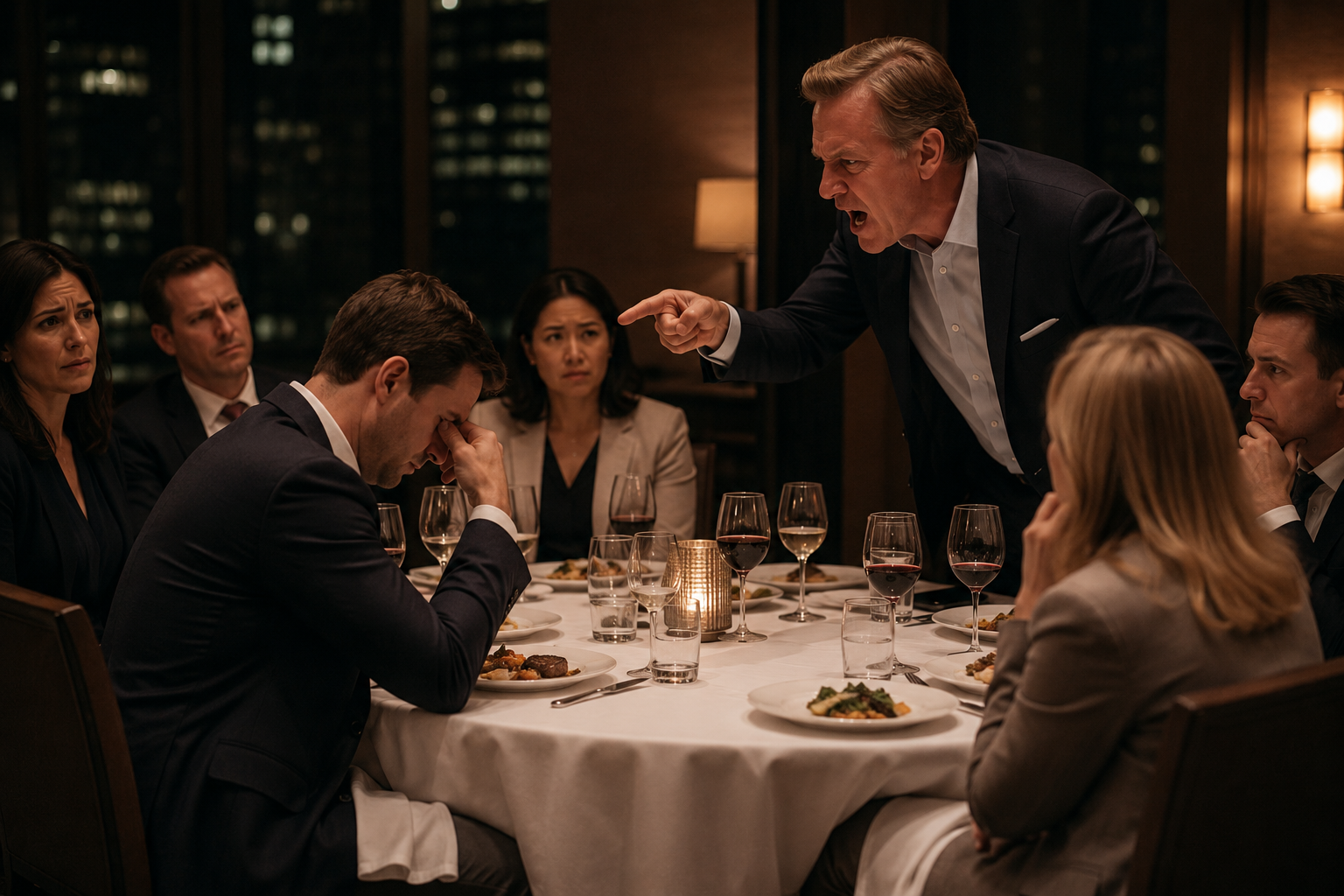
You are at dinner with your boss and his entire team of direct reports, your colleagues. A public restaurant, a good one. Wine has been poured, the conversation is easy, and for a while it is exactly what these dinners are supposed to be.
Then, somewhat out of nowhere, your boss turns on you. Not a pointed question or a sharp aside. He starts berating you, openly, in front of the whole table. This is out of character for him. In the years you have worked together he has never done anything like this, and certainly never to you. Overall the two of you have a strong relationship, though if you are honest, there has been tension between you lately. Apparently it just found its way to the surface, over dinner, with an audience.
The table goes silent. Forks pause. Everyone turns and looks at you. The servers can probably hear it. Whatever happens in the next thirty seconds, every colleague at that table will remember it.
So, what would you do?
The Three Traps
The heat of a moment like this pulls hard toward three responses, and all three cost you more than they return.
The Counterpunch.
You match his energy. You defend yourself point by point, or you take a shot back at him. It might even feel justified. But now the table is watching two people lose composure instead of one, and you have converted his lapse into a shared spectacle. Worse, you have given anyone inclined to explain away his behaviour a way to do it: well, it got heated on both sides.
The Collapse.
You apologize, over-explain, and absorb the whole thing to make the awkwardness stop. The table relaxes, but at your expense. You have just taught everyone present, including your boss, that this is an acceptable way to deal with you. Appeasement in public is expensive, and the bill arrives later.
The Vanishing Act.
You laugh it off, change the subject, and pretend it did not happen. Then you keep pretending. The dinner ends, nobody speaks of it, and the tension that produced the outburst stays exactly where it was, now with a public incident layered on top of it.
Reframing the Real Question
Here is the shift. The question in that moment is not “how do I win this exchange?” or even “how do I make it stop?” The question is, what does this room learn about me in the next thirty seconds?
Your colleagues are watching how you carry yourself under unfair pressure, and your boss, somewhere beneath the outburst, is watching too. Composure in that moment is the most powerful position at the table. The person who keeps their dignity when someone else has lost theirs almost always owns the room, without saying much at all.
The second reframe matters just as much. The dinner is not the real issue. The tension is. The outburst is a symptom of something the two of you have not dealt with, and no response at the table, however skillful, resolves that. The table is for containment. The resolution happens later, in private.
What I Would Do?
In the moment, respond low and slow.
Do not match his volume or his heat. Look at him directly, stay calm, and say something short and unmistakably steady. Something like, "I hear that you are frustrated with me. This is not the place for that conversation, and I am not going to have it here. Let's take it up tomorrow, just the two of us." Then stop talking. Do not fill the silence, do not plead your case, do not look around the table for allies. You have declined the fight without running from it, and you have named a boundary in a way no reasonable person at that table can fault.
Give the dinner a path back.
If he backs off, let him. You do not need an apology at the table, and demanding one publicly corners him. Turn to a colleague, pick up a thread of conversation, and allow the evening to recover. Grace here is you deciding the temperature of the room when he could not.
If he keeps going, leave well
If the berating continues after you have drawn the line, stand up calmly, put your napkin down, and excuse yourself without drama. "I meant what I said. I will see everyone tomorrow." Quietly settle your portion on the way out if you can. Walking out with composure is not a scene. Staying seated while being publicly degraded would be.
Have the real conversation within a day
Request the one on one promptly, and go in curious before you go in wounded. Open with the behavior, not the biography: "Last night was not like you, which tells me something bigger is going on between us. I want to understand what it is." Then listen. The tension you have both been stepping around is the actual agenda. Say your piece about the dinner clearly, once, without relitigating it: public criticism of you in front of the team is a line, and you need his agreement that it will not happen again.
Watch what happens next.
A strong relationship can survive one bad night, and if he owns it, this episode may actually deepen the trust between you. People reveal themselves in how they repair, not just in how they stumble. But if he minimizes it, blames you for his outburst, or it happens again, you have learned something important about the relationship you thought you had, and you should recalibrate accordingly.
The Bottom Line
You do not control your boss's worst moments. You fully control your own response to it, and that response is the loudest thing anyone at the table will hear. Meet a public loss of composure with private courage: calm at the table, candor in the office, and a clear line about your dignity that you are willing to hold in both places. The colleague people remember from that dinner should be you, and for the right reason.
Think Big, Start Small, Act Now,
Lorne
P.S. I wish I would have had the insight above. When it happened to me I fell into trap one; I counter punched. Dinner ended awkwardly. Ironically, we ended up on the elevator with just the two of us, apologized to each other, gave each other a big hug and never really talked about it again. We are friends to this day. However it would have been more constructive for all if I had responded low and slow, followed up, and then moved forward accordingly; including communicating to the rest of the team. We missed leadership learning moments although demonstrating that we could fight like brothers and move on. Our bosses are usually not family. So we stumbled more than learned forward.
This closes the Dilemma series. Every situation came down to the same quiet truth: character is not what you believe in the abstract, it is what you do in the thirty seconds when everyone is looking at you, and in the private conversations nobody sees.
Also, don’t forget to subscribe to our newsletter for these blogs to arrive in your email every Tuesday morning.
Have you watched any of our new episodes of Culture Talks with my new co-host, Dave McCauley! They’re a lot of fun. Here’s an exclusive clip from this Wednesday’s upcoming podcast, Culture Talks: Does Employee Retention Still Matter? AI, Glassdoor & Company Values Exposed.
Like and subscribe for more!
Garrett’s View: Yeah, this is black belt level of circumnavigating awkwardness, letting cooler heads prevail and practicing self-control. This is why I propose all business dinners take place at a Margaritaville, where vibes are too high for this to ever happen.
- Garrett
AI Response: Research on manager-employee dynamics backs up the stakes Lorne is describing here — studies show the manager alone accounts for roughly 70% of the variance in team engagement, while the broader workplace relationship drives about 39% of overall job satisfaction. On the harder edge of the topic Lorne is dancing around, nearly half of American adults report having experienced abusive behavior at work, yet only about 12% of U.S. employers actually act to eliminate it — which underscores why Lorne's emphasis on private, direct follow-up (rather than letting the moment pass silently) matters practically, not just for dignity's sake. It also tracks with broader manager-effectiveness research: a SHRM survey found 84% of U.S. workers say poorly managed relationships with their boss create significant unnecessary stress, reinforcing the piece's core claim that the follow-up conversation, not the dinner-table moment itself, is where the relationship actually gets decided. SSRN
Search Blog Posts:
Categories
Month
- October 2026
- September 2026
- August 2026
- July 2026
- June 2026
- May 2026
- April 2026
- March 2026
- February 2026
- January 2026
- December 2025
- November 2025
- October 2025
- September 2025
- August 2025
- July 2025
- June 2025
- May 2025
- April 2025
- March 2025
- February 2025
- January 2025
- December 2024
- November 2024
- October 2024
- September 2024
- August 2024
- July 2024
- June 2024
- May 2024
- April 2024
- March 2024
- February 2024
- January 2024
- December 2023
- November 2023
- October 2023
- September 2023
- August 2023
- July 2023
- June 2023
- May 2023
- April 2023
- March 2023
- February 2023
- January 2023
- December 2022
- November 2022
- October 2022
- September 2022
- August 2022
- July 2022
- June 2022
- May 2022
- April 2022
- March 2022
- February 2022
- January 2022
- December 2021
- November 2021
- October 2021
- September 2021
- August 2021
- July 2021
- June 2021
- May 2021
- April 2021
- March 2021
- February 2021
- January 2021
- December 2020
- November 2020
- October 2020
- September 2020
- August 2020
- July 2020
- June 2020
- May 2020
- April 2020
- March 2020
- February 2020
- January 2020
- December 2019
- November 2019
- October 2019
- September 2019