
What Nations Figured Out About Measurement That Most Companies Still Have Not
Here are two numbers.
On the United Nations Human Development Index, Canada scores 0.939. The United States scores 0.938. One thousandth of a point apart. Sixteenth and eighteenth in the world. If you were reading a press release, you would say these are the same country.
Now adjust those scores for how evenly the gains are actually distributed across the population. Canada holds at 0.867 and moves to fourteenth. The United States drops to 0.832 and falls to twenty ninth, an 11.3 percent loss, the largest inequality discount among the top twenty countries on the index.
Same headline. Completely different country underneath.
I have been thinking about that gap all week, because it is the single best description I have found of what goes wrong inside organizations.
The Bridge
Nations learned this lesson decades ago. GDP alone tells you almost nothing about whether a country is healthy, so the world built better instruments - the Human Development Index, the OECD Better Life Index, the World Happiness Report. All of them are multi-dimensional on purpose: economic output, health and education, trust and safety, environmental sustainability.
Most organizations never made that leap. Revenue, margin, EBITDA, and an annual engagement survey that gets presented once and filed. That is the GDP only version of company health.
I am not making the soft argument here. I have run P&Ls. Financial performance is the price of admission, not one consideration among many. However financial results are lagging indicators. By the time a culture problem shows up in your quarterly numbers, it has been running for two years and it is expensive to fix. Every company I have watched come apart, came apart in the culture first and the financials second. The scorecard was still green while the building was on fire.
That is the case for measuring more than money. It is not, however, today's problem. Today's problem is what happens once you add those extra measures, because most leaders make the exact same mistake with them that they made with revenue: they collapse everything into one number and call it done.
The Average is Where Accountability Goes to Hide
Your organization runs an engagement survey. It comes back at 7.4. Leadership is pleased. The deck says progress.
Now break that 7.4 apart. By division. By level. By tenure. By location. In most organizations you will find a 9 somewhere near the top of the house and a 4 somewhere on the front line, and the 7.4 was hiding both of them. The average was not wrong. It was just useless, in exactly the way that 0.938 was useless until somebody adjusted it for distribution.
This is not unique to engagement scores. It is true of every measure you have, including the human-and-trust ones nations figured out how to track: healthy tenure, ninety day new hire failure rates, psychological safety, speak up channel usage. Report any of them as a single company-wide mean, and you will get a number that flatters leadership and protects whichever group is actually struggling.
What Leaders Should Actually Do
Three moves, starting with your next reporting cycle:
1. Never publish a mean without a spread. Every people metric you report - engagement, retention, trust, safety - should come with the range, not just the average. Highest scoring group, lowest scoring group, and the trend for the lowest group specifically.
2. Cut every number at least three ways. By level, by tenure, and by team or location. If you only have the resources to cut one number this way, cut engagement - it is usually where the widest gaps hide.
3. Name the lowest scoring group in the room, every time. Not to punish it. To make it impossible for the deck to say "progress" while a quarter of the organization is quietly struggling. The group at the bottom of the spread is where your next culture problem is already forming.
It will be uncomfortable the first time you do this. It is also the fastest honest read you will ever get on the health of your organization.
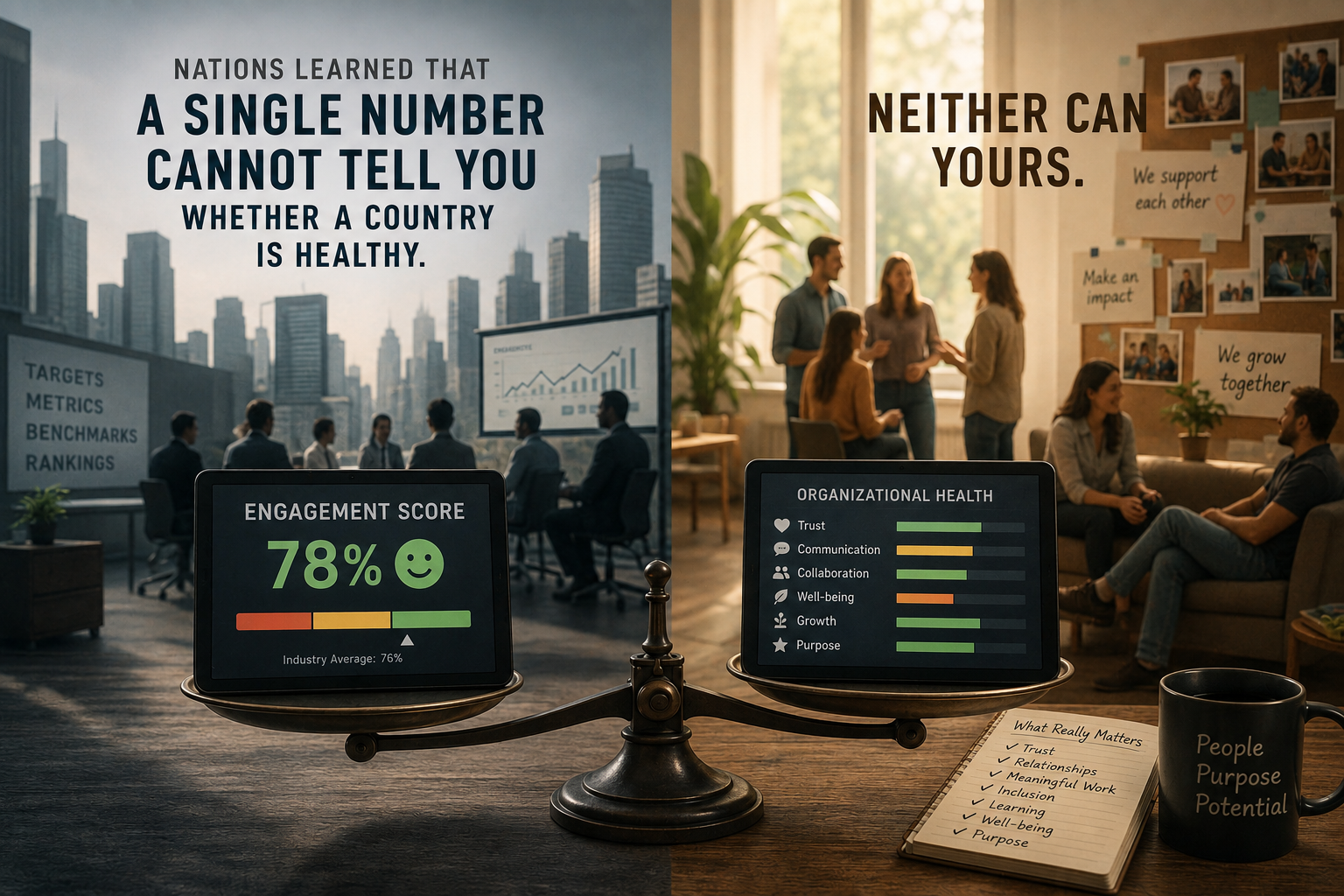
Nations learned that a single number cannot tell you whether a country is healthy. Neither can yours.
Think Big, Start Small, Act Now,
- Lorne
Have you watched any of our new episodes of Culture Talks with my new co-host, Dave McCauley! They’re a lot of fun. Here’s an exclusive clip from this Wednesday’s upcoming podcast, Culture Talks: How to Stay Calm Before Hard Conversations.
Like and subscribe for more!
Garrett’s View: Ah yes, the averages might diagnose that our companies are not going to keel over. Phew! However, even if we’re performing well, it’s not a sprint. It’s not a marathon. It’s a never-ending decathlon, and there are events we can always improve on.
- Garrett
AI Response: Gallup's 2024 State of the Global Workplace found only 23% of employees worldwide are engaged at work, and engagement is consistently among the most unevenly distributed metrics inside organizations — Gallup's own team-level data shows engagement scores can swing by 20+ percentage points between the best and worst-performing teams under the same company average. Separately, McKinsey's research on organizational health (the OHI index) has found that top-quartile companies on organizational health deliver roughly three times the total shareholder return of bottom-quartile companies over time — a strong empirical anchor for the piece's core claim that financial results are a lagging indicator of organizational health, not a leading one.
Search Blog Posts:
Categories
Month
- October 2026
- September 2026
- August 2026
- July 2026
- June 2026
- May 2026
- April 2026
- March 2026
- February 2026
- January 2026
- December 2025
- November 2025
- October 2025
- September 2025
- August 2025
- July 2025
- June 2025
- May 2025
- April 2025
- March 2025
- February 2025
- January 2025
- December 2024
- November 2024
- October 2024
- September 2024
- August 2024
- July 2024
- June 2024
- May 2024
- April 2024
- March 2024
- February 2024
- January 2024
- December 2023
- November 2023
- October 2023
- September 2023
- August 2023
- July 2023
- June 2023
- May 2023
- April 2023
- March 2023
- February 2023
- January 2023
- December 2022
- November 2022
- October 2022
- September 2022
- August 2022
- July 2022
- June 2022
- May 2022
- April 2022
- March 2022
- February 2022
- January 2022
- December 2021
- November 2021
- October 2021
- September 2021
- August 2021
- July 2021
- June 2021
- May 2021
- April 2021
- March 2021
- February 2021
- January 2021
- December 2020
- November 2020
- October 2020
- September 2020
- August 2020
- July 2020
- June 2020
- May 2020
- April 2020
- March 2020
- February 2020
- January 2020
- December 2019
- November 2019
- October 2019
- September 2019