
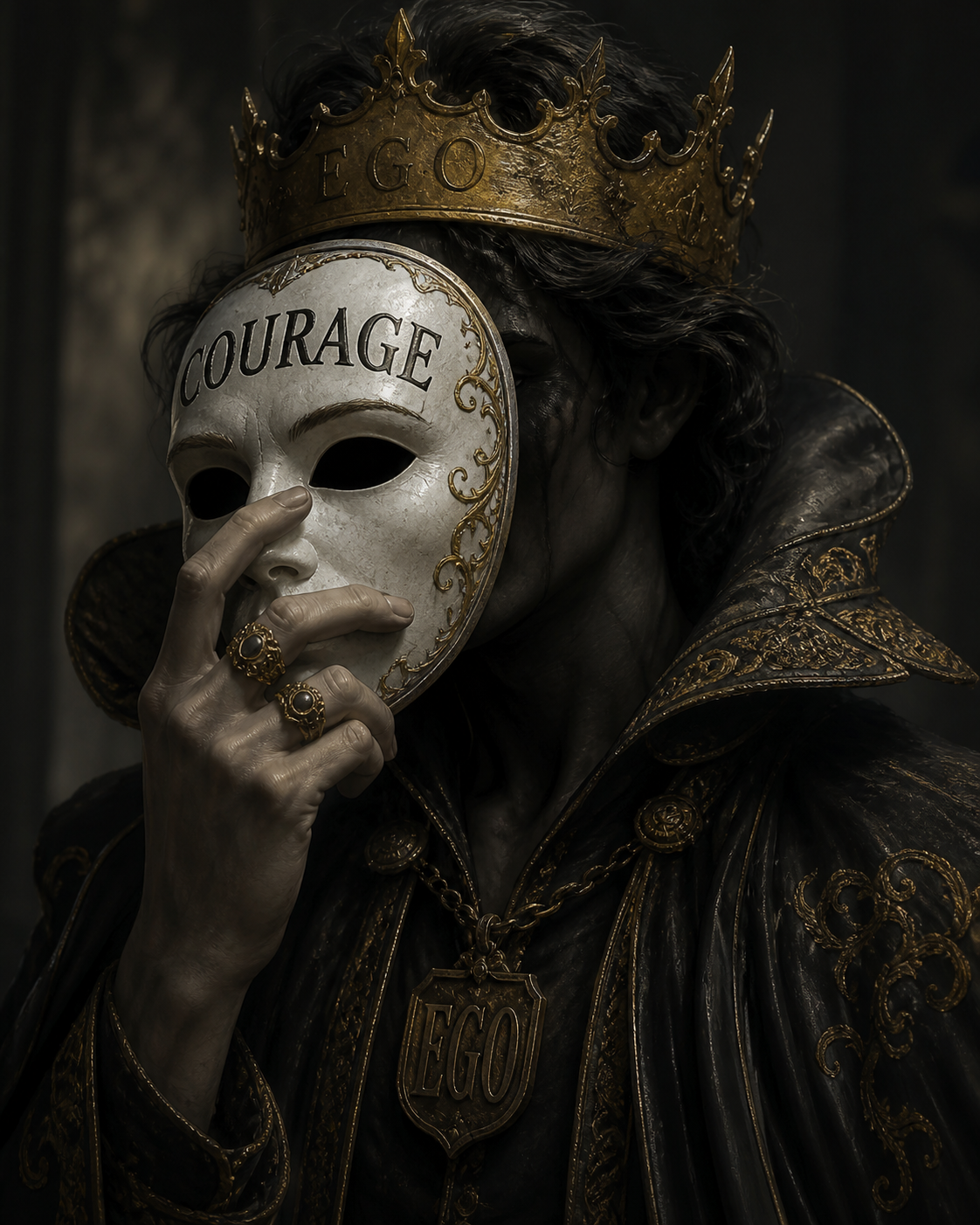
When Ego Wears the Mask of Courage
I just notched another birthday that puts me solidly in the second half of seven decades. The research actually reassures me, noting that our 70s and 80s can be the most fulfilling decades from an emotional and spiritual standpoint. That framing matters. Just as physical investment in our younger years shapes our wellbeing later, there is a compelling parallel in investing in emotional and spiritual fitness earlier. The returns compound.
There is a continuum, and older people tend to land in one of two places: content and grateful, or bitter and resentful. That observation sent me toward the wisdom of St. Benedict:
“The first task of spiritual life is learning to see your own reactions clearly: how quickly anger justifies itself, how easily fear pretends to be wisdom, how often ego disguises itself as courage. Silence exposes all of that, not to shame people, but to free them. Stay rooted. Stay practiced in humility and courage. Stay shaped by love more than by fear. The goal is freedom, the kind that lets you remain fully human when systems forget how.”
I believe it is anger, fear, and false courage that lead to that lasting bitterness and resentment. Benedict’s words carry much to digest, but one phrase stops me every time: “ego disguised as courage.”
I still think about a moment from earlier in my career. I was in a room with senior leaders, convinced I was the one willing to say what others would not. I felt the clarity of it, the moral weight. I was speaking truth to power, or so I told myself. And maybe, in part, I was. However somewhere in that room, something shifted. The courage became about being seen as courageous. I stopped listening. I stopped leaning into the discomfort of genuine curiosity. Instead, I invested my energy confirming my own righteousness. My ego had taken over, and it had done so quietly, wearing exactly the right disguise.
That behavior rarely produces good outcomes, for the people in the room or for the person who cannot see what is actually driving them.
The world needs more courageous leaders. However courage without humility is just ego with better posture. The real question is not whether you are right. It is whether you are genuinely trying to do right. Those are not the same thing, and the gap between them is where self-deception lives.
When anger starts justifying itself, when fear begins presenting as wisdom, that is your signal to pause. Not to retreat, but to reflect. To ask honestly what is underneath the certainty. In the middle of it, that is harder than it sounds. It requires people around you who care enough to raise the caution flag, and it asks you to have built the kind of relationships where that is possible.
My younger self would have benefited enormously from Benedict’s insight. Perhaps you will find it useful to consider this: humility and courage are not opposites. They are partners. And countering fear with love, rather than with more armor, is not weakness. It is the hardest and most necessary work of leadership.
I am still working on it. And that takes genuine courage.
Think Big, Start Small, Act Now,
- Lorne
Garrett’s View: We want the complete story as abridged as possible, and know we have a matter of seconds to command or retain attention. When presented with a situation, we either make the extra effort to ingest the nuances, or more often, we decide we can’t be bothered with it and just associate with those who agree. You don’t need a neuroscience degree to know that defaulting to agreement doesn’t dissolve anger, fear or ego, it just parks them. It’s that fleeting pause for reflection that we actually want, we just know it’s a harder route that takes time we pretend we don’t have.
- Garrett
AI Response: The tension Lorne describes between ego and genuine courage has measurable consequences in organizational life. Research from Harvard Business Review found that leaders who score high in humility consistently outperform their peers on team performance and employee engagement. Studies on psychological safety — most notably Google's Project Aristotle — found that the single greatest predictor of high-performing teams wasn't talent or strategy, but whether team members felt safe enough to speak honestly without fear of judgment. That requires exactly the kind of leader Lorne describes: someone who has done the inner work to tell the difference between performing courage and actually practicing it. And the stakes are real — Gallup's ongoing workplace research consistently shows that the majority of employees are disengaged, with poor leadership culture cited as a primary driver. Benedict framed it as a spiritual problem. The data frames it as an organizational one. They're pointing at the same thing.
Search Blog Posts:
Categories
Month
- September 2026
- August 2026
- July 2026
- June 2026
- May 2026
- April 2026
- March 2026
- February 2026
- January 2026
- December 2025
- November 2025
- October 2025
- September 2025
- August 2025
- July 2025
- June 2025
- May 2025
- April 2025
- March 2025
- February 2025
- January 2025
- December 2024
- November 2024
- October 2024
- September 2024
- August 2024
- July 2024
- June 2024
- May 2024
- April 2024
- March 2024
- February 2024
- January 2024
- December 2023
- November 2023
- October 2023
- September 2023
- August 2023
- July 2023
- June 2023
- May 2023
- April 2023
- March 2023
- February 2023
- January 2023
- December 2022
- November 2022
- October 2022
- September 2022
- August 2022
- July 2022
- June 2022
- May 2022
- April 2022
- March 2022
- February 2022
- January 2022
- December 2021
- November 2021
- October 2021
- September 2021
- August 2021
- July 2021
- June 2021
- May 2021
- April 2021
- March 2021
- February 2021
- January 2021
- December 2020
- November 2020
- October 2020
- September 2020
- August 2020
- July 2020
- June 2020
- May 2020
- April 2020
- March 2020
- February 2020
- January 2020
- December 2019
- November 2019
- October 2019
- September 2019