
Wildfires and Wild Times
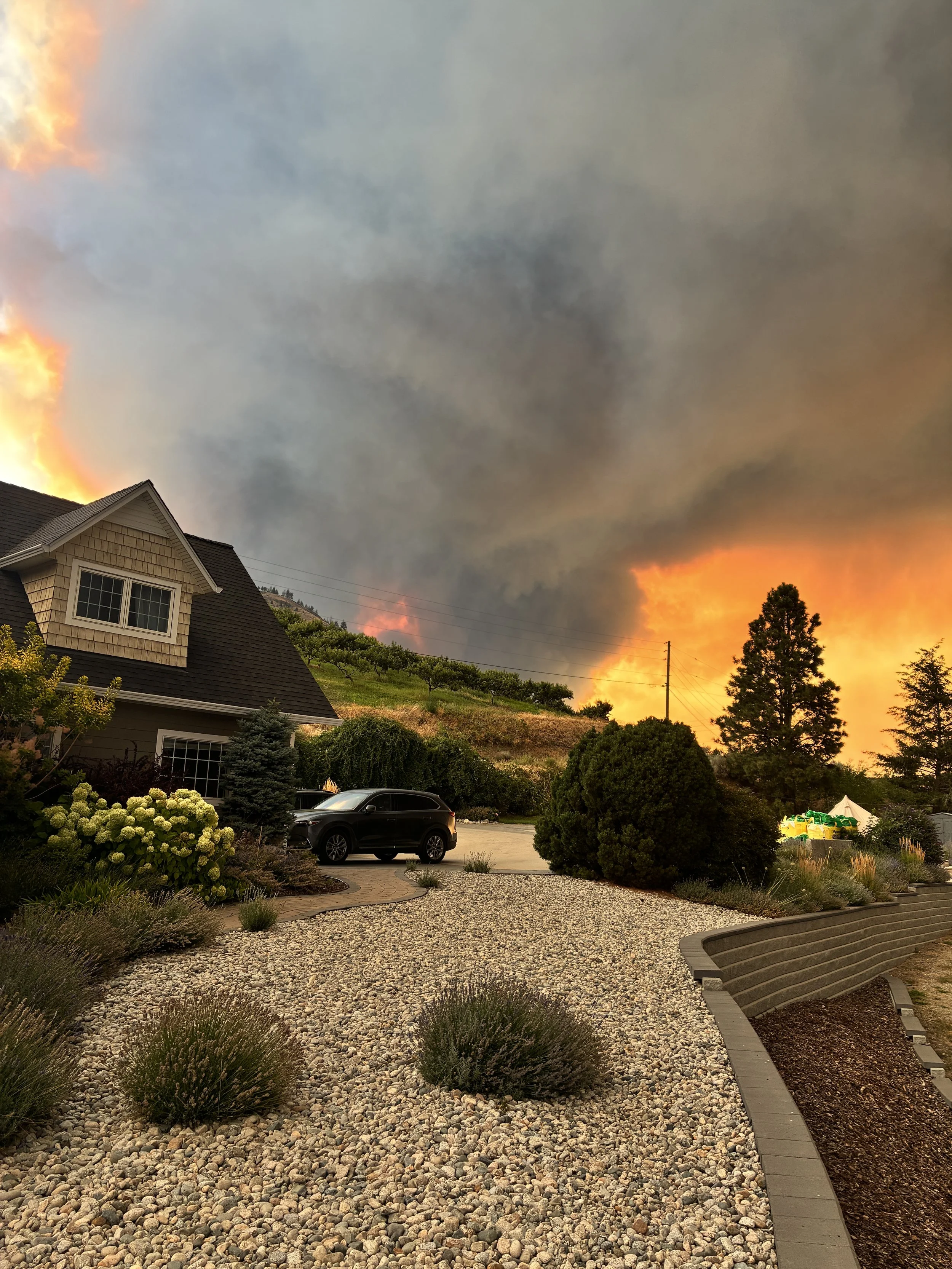
Minutes before evacuation, outside of our daughter’s home on Friday, 8/7
As I write this, our eldest daughter's family has evacuated. They do not know yet whether their home is still standing.
We live in Canada’s Okanagan. Right now it is a tinder box. The Bald Range fire was spotted Friday evening and grew to fifty square kilometres in three hours. Just after midnight, the entire District of Summerland was ordered out. Add Peachland and the number climbs past 20,000 people. British Columbia is now under a provincewide state of emergency. The provincial wildfire director called the fire “explosive” and has not seen conditions like these before.
Across the border, three fires around Spokane displaced roughly 65,000 people and destroyed more than eight hundred structures in a single weekend. Before that, Australia. Lahaina. The Palisades. Paradise. Then Europe. Add the floods, tornadoes, heat domes, and ice storms.
Whatever you believe about science, the operating reality is not in dispute. This is more of a condition than a season.
So what does a wildfire have to do with organizational culture and leadership?
Everything.
Because the moment a family loses its home, or waits five days to find out, the workplace assumptions we have carried for decades stop working. We assume employees arrive whole. We assume home life and work life sit in separate boxes. We assume disruption is temporary and recovery is quick.
None of that survives contact with an evacuation order.
If you have never been on the receiving end of one, it is hard to appreciate how completely it takes over. There is no bandwidth left. Getting resettled consumes everything. Expecting people to carry on producing under those conditions is a failure of leadership imagination.
Here is what I think advanced organizations will do, and are already starting to do. Not as a gesture, but as infrastructure.
Crisis leave that is real. Separate from vacation. Separate from sick time. Measured in weeks, not days, and granted without an employee having to ask twice or justify their grief.
Money that moves fast. Advances, not reimbursements. Insurance takes months. Bills are due now. An organization that can move a purchase order in 48 hours can move an emergency payment in 48 hours.
Someone who calls first. Do not wait for the employee to call in. Assign a named person to reach out, keep contact, and carry the administrative load so the employee does not have to navigate benefits paperwork from a hotel room.
Mental health support with a long tail. The hardest stretch is not the week of the fire. It is month four, when the adrenaline is gone, the news trucks have left, and the world has moved on.
Flexibility measured in seasons. Rebuilding a life takes a year, not a long weekend.
None of this is expensive relative to the cost of losing good people, or the cost of what employees will remember about you for the rest of their careers.
Culture is not what we say about ourselves in a good quarter. It is what we actually do for people on the worst day of their lives.
Those days are arriving more often, for more of our people, and the organizations that have thought this through in advance will be the ones still standing when the smoke clears.
So the question is not whether your organization cares. Everyone says they care.
The question is whether your support is written down, funded, and known to your people before they need it.
What is your organization doing about this?
Think Big, Start Small, Act Now,
- Lorne
Garrett’s View: I can compartmentalize with the best of them. But these fires are downright disruptive. What we predominantly see succeeding in these situations is immediate, fast-response community outreach that dramatically rescues and rebuilds the people most affected. Your organization, however big or small, is your immediate community. Take care of it accordingly.
- Garrett
AI Response: The Bald Range fire has continued to escalate since Friday's ignition: it forced more than 20,000 people under wildfire-related evacuation orders across B.C., and by Saturday morning it had doubled overnight to burn over 95 square kilometres. More than 2,600 properties remained under evacuation order and another 312 on alert overnight, and Premier David Eby confirmed in a Saturday briefing that homes had been lost and properties destroyed. It's one of 104 active wildfires burning in B.C. at the time. On the organizational research side, the case for Lorne's "infrastructure not gesture" argument is backed by data: in organizations that show a proactive commitment to disaster response, 73% of employees, both those personally affected and those not, agree that assistance efforts like paid leave, flexible hours, and remote options make a difference.
Search Blog Posts:
Categories
Month
- September 2026
- August 2026
- July 2026
- June 2026
- May 2026
- April 2026
- March 2026
- February 2026
- January 2026
- December 2025
- November 2025
- October 2025
- September 2025
- August 2025
- July 2025
- June 2025
- May 2025
- April 2025
- March 2025
- February 2025
- January 2025
- December 2024
- November 2024
- October 2024
- September 2024
- August 2024
- July 2024
- June 2024
- May 2024
- April 2024
- March 2024
- February 2024
- January 2024
- December 2023
- November 2023
- October 2023
- September 2023
- August 2023
- July 2023
- June 2023
- May 2023
- April 2023
- March 2023
- February 2023
- January 2023
- December 2022
- November 2022
- October 2022
- September 2022
- August 2022
- July 2022
- June 2022
- May 2022
- April 2022
- March 2022
- February 2022
- January 2022
- December 2021
- November 2021
- October 2021
- September 2021
- August 2021
- July 2021
- June 2021
- May 2021
- April 2021
- March 2021
- February 2021
- January 2021
- December 2020
- November 2020
- October 2020
- September 2020
- August 2020
- July 2020
- June 2020
- May 2020
- April 2020
- March 2020
- February 2020
- January 2020
- December 2019
- November 2019
- October 2019
- September 2019