
Why I Add Organization Influencers into Culture Initiatives
Organization wide culture initiatives, if they are going to be successful, require direct ownership and personal investment from the CEO and the C Suite. Not endorsement. Not a nod in a town hall. Ownership.
The top HR officer plays an important role, often the most important design role in the whole effort, but ideally is not the primary sponsor. When culture work lives in HR, the organization reads it as a program. When it lives with the CEO, the organization reads it as the business. The CEO is the Chief Culture Officer. That is not a clever line, it is a job description.
And yet, after more than three decades of doing this work with leadership teams, I have learned that flawless executive sponsorship is still not enough. The C Suite can be aligned, articulate, and genuinely committed, and the initiative can still stall somewhere between the boardroom and the front line. The reason is simple. People do not believe a culture's message because a senior leader says it. They believe it when someone they trust, who has nothing to gain from saying it, shows them it’s a priority.
That is why, in every engagement, I encourage the C Suite to recruit and select internal influencers to work alongside them as guides and reality testers.
Who I Mean by “Influencer”
I am not talking about high potentials on a succession slate, and I am definitely not talking about the most vocal people in the building. I am talking about the people whose opinion others quietly seek before they form their own. Every organization has them. Ask any leader to name the five people whose buy in would move their area, and they will likely have that list. Very few of those names will be on an org chart at a senior level.
The two criteria I care most about are these. First, they collectively represent all parts of the organization, including the shop floor, the field, the call center, the plant, the shift that nobody visits. Second, and this is the one people often underestimate, they are respected for their character, not their position. Accountability, respect, and abundance show up in how they treat people when there is no upside for them. That is the currency they lend to the work.
The Skills They Already Have
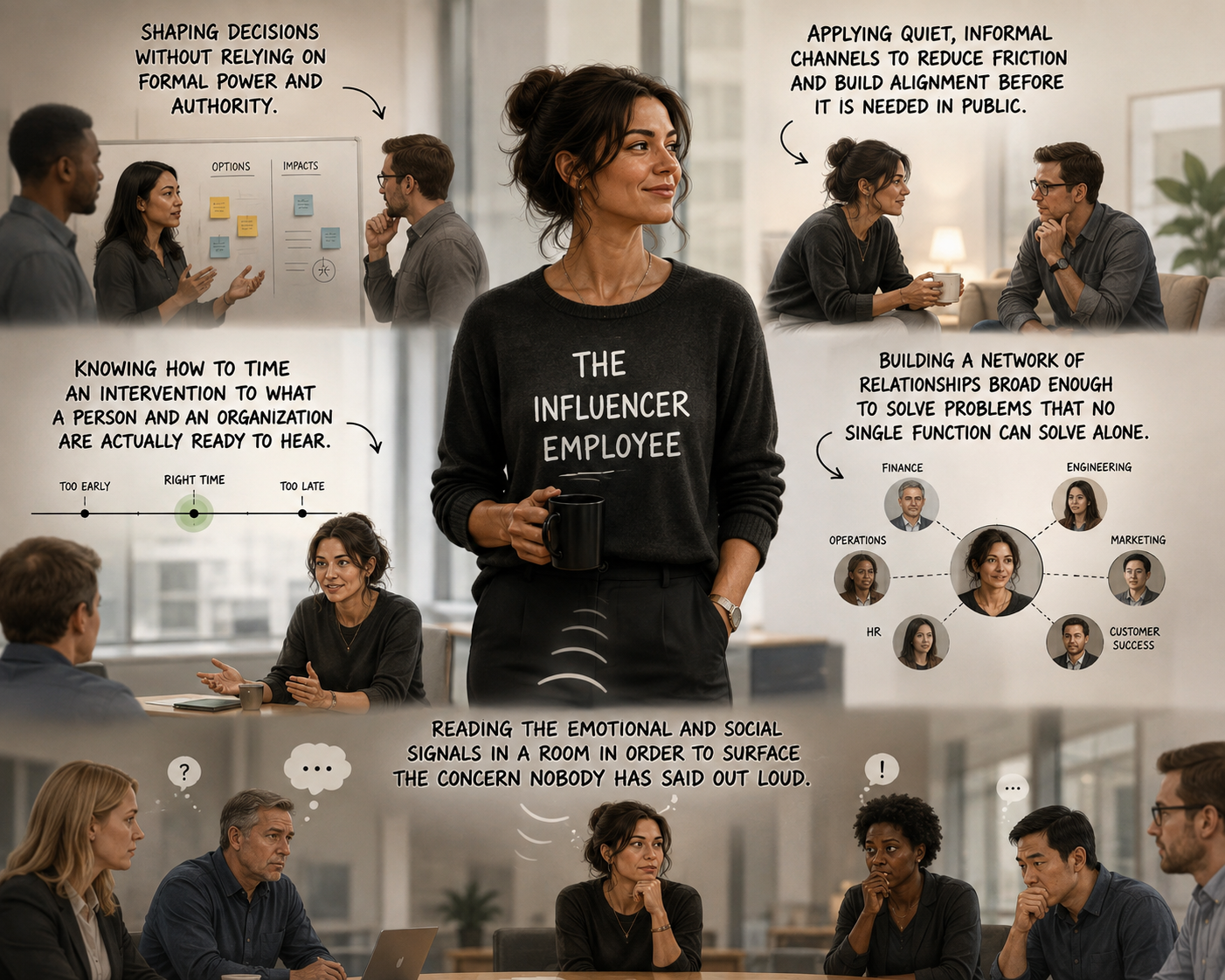
Pamela Meyer’s article in the September and October 2026 issue of Harvard Business Review, "5 Ways to Wield Influence When You Lack Authority," is a useful reference here because it describes precisely the capability set these people bring. Meyer’s argument is that formal authority is becoming a weaker instrument, and that leaders increasingly have to shape outcomes they do not control. She points to five attributes and approaches impact influencers demonstrate. I summarize them in my own words as follows.
Shaping decisions without relying on formal power and authority .
Applying quiet, informal channels to reduce friction and build alignment before it is needed in public.
Knowing how to time an intervention to what a person and an organization are actually ready to hear.
Building a network of relationships broad enough to solve problems that no single function can solve alone.
Reading the emotional and social signals in a room in order to surface the concern nobody has said out loud.
The thread running through all five, in Meyer’s framing, is creating conditions where people choose to act rather than feeling forced to comply.
Read that list again and ask yourself who in your company already does all five instinctively. Those are your influencers. They are doing it today, on behalf of whatever they currently believe. The question is only whether the culture initiative has their conviction or their skepticism.
What I Ask Them to Do
Two things, and I am specific about the difference.
As guides, they translate. They help carry the reason underlying the culture work and action being taken into ordinary conversation, which is the practical place culture actually lives.
As reality testers, they inform the C Suite, leadership system as a whole and advisors like me what people say when leaders leave the room. That is the part executives find hardest and value most. As much as we may all value psychological safe environments, people are often wary about sharing how they really feel.
The Ask. And What They Get in Return
Ask them for candor, and establish advocacy based on trust. The moment influencers become simple message carriers for leadership, they forfeit the trust that made them valuable.
Give them real access and real protection. Direct time with the CEO, a clear signal that their influence is valued and at least one visible instance where something they said changed a decision.
Recognize and acknowledge the valuable role they play.
Culture progress is ultimately a question of belief, and belief travels through relationships, not through cascades. The C Suite (and the rest of the formal leadership) owns it. The influencers help make it credible. You need both.
Think Big, Start Small, Act Now,
Lorne
Garrett’s View: This seems like an evolution that has been in your repertoire for a while now. You can read about a similar initiative to recruit G-Evangelists in a former blog. In 2026, influencers are likely more plentiful with the familiarity to be impactful and accepted.
AI Response: The data backs up Lorne's core claim here. Gallup research puts trust in organizational leadership at only 23% of employees strongly agreeing they trust their organization's leadership, while separate 2026 research found just 21% of employees trust their leadership — underscoring why message credibility can't flow from the C-Suite alone. Meanwhile, peer dynamics tell the opposite story: conversations with coworkers are the top source of inspiration for employees, with 68% of employees saying they have at least one coworker who inspires them at work. Research on trust-building itself reinforces Lorne's "no upside for them" point about influencer credibility — one 2026 study found employees who give peer recognition are trusted 9x more than those who don't, and that when a high-trust individual moves to a new team, that team's trust scores rise within 30 days, suggesting trusted individuals genuinely do function as "catalysts" the way Lorne describes influencers operating. There's also a business case for urgency: high-trust companies deliver 3.5x the stock market returns over 27 years and 8.5x greater revenue per employee compared to low-trust peers.
Search Blog Posts:
Categories
Month
- September 2026
- August 2026
- July 2026
- June 2026
- May 2026
- April 2026
- March 2026
- February 2026
- January 2026
- December 2025
- November 2025
- October 2025
- September 2025
- August 2025
- July 2025
- June 2025
- May 2025
- April 2025
- March 2025
- February 2025
- January 2025
- December 2024
- November 2024
- October 2024
- September 2024
- August 2024
- July 2024
- June 2024
- May 2024
- April 2024
- March 2024
- February 2024
- January 2024
- December 2023
- November 2023
- October 2023
- September 2023
- August 2023
- July 2023
- June 2023
- May 2023
- April 2023
- March 2023
- February 2023
- January 2023
- December 2022
- November 2022
- October 2022
- September 2022
- August 2022
- July 2022
- June 2022
- May 2022
- April 2022
- March 2022
- February 2022
- January 2022
- December 2021
- November 2021
- October 2021
- September 2021
- August 2021
- July 2021
- June 2021
- May 2021
- April 2021
- March 2021
- February 2021
- January 2021
- December 2020
- November 2020
- October 2020
- September 2020
- August 2020
- July 2020
- June 2020
- May 2020
- April 2020
- March 2020
- February 2020
- January 2020
- December 2019
- November 2019
- October 2019
- September 2019