
Big Brother, Big Sister, or Just Bad Leadership?
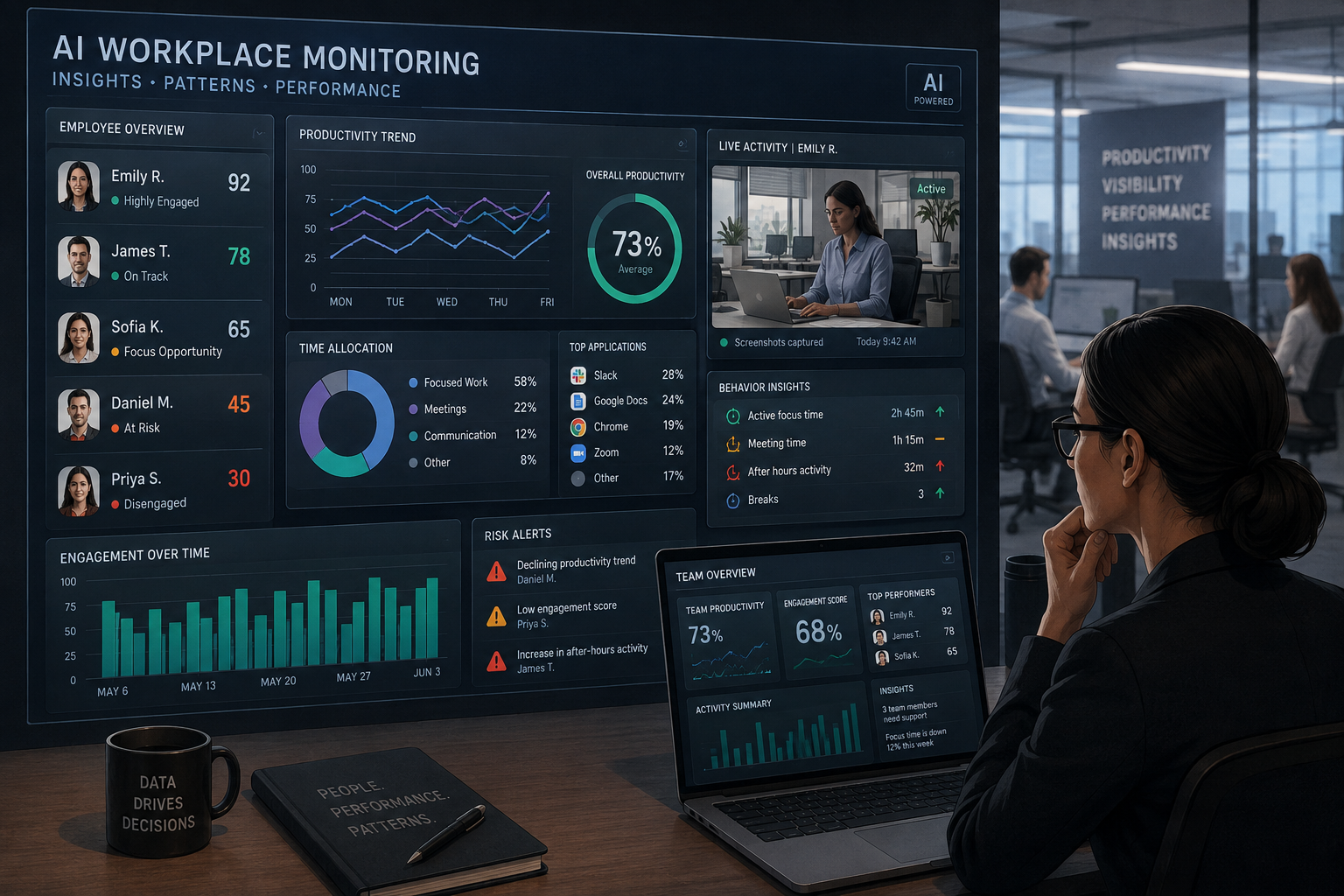
Someone forwarded me a Wall Street Journal piece this week with the headline, “How to Outsmart AI When It’s Tracking Your Workday.” Sit with that for a moment. It is not an article about how to do better work. It is an article about how to look like you are doing better work in the eyes of an algorithm.
The reporting is practical and, in its own way, useful. The newer monitoring platforms now cross reference your Slack or Outlook status against your calendar, so an in person meeting or an old fashioned phone call is not logged as an extended coffee break. Constant one hundred percent activity trips an anomaly alert, because the systems have learned to spot mouse jigglers. Heavy AI usage, which earned you innovation points eighteen months ago, can now read as waste, because finance is watching token spend.
All of it is rational. All of it makes me uneasy.
Here is the reason. The moment people begin optimizing for the dashboard, the dashboard stops telling you the truth. You have not built a measurement system. You have built a theatre, and you are the one buying the tickets.
Is there merit? Yes, and it is narrower than the vendors suggest
I am not against measurement. I have spent a career arguing that culture is measurable and that leaders who refuse to measure it are usually protecting themselves rather than all people. There are legitimate uses for these tools. Security and regulatory obligations are real. Fatigue management in operating environments is a safety matter, not a productivity matter. Understanding where the work actually goes, how much of a week disappears into meetings, how many handoffs a file survives, where the queue reliably backs up, is genuinely valuable, and most executive teams are guessing about it.
Notice what those uses have in common. They point at the design of the work, not at the character of the worker. They diagnose the system. The trouble begins the moment the same data is aimed at an individual.
Four principles that separate development from surveillance
One. Transparency without exception. People know exactly what is collected, why, who sees it, how long it is kept, and which decisions it informs. My simple test is this: if you would not say it out loud at a town hall, do not collect it.
Two. Aggregate by default, individual only for cause. Team and process level insight is where the value is anyway. Individual level scrutiny should require a specific, documented, and disclosed reason, the same standard you would want applied to yourself.
Three. The data starts a conversation, it never ends one. A dashboard is a question, not a verdict. It cannot see the person managing a crisis at home, the colleague quietly carrying a struggling teammate, or the two hours of hard thinking done on a walk that produced the best idea of the quarter.
Four. Reciprocity. Employees of all levels should see their own data. Leaders need to publish theirs too. Monitoring that only flows downhill is not measurement. It is a hierarchy with a software licence.
Regular readers know I run most things through the Character Triangle. Be accountable, respectful and abundant. Monitoring passes that test when it makes people more accountable to outcomes they helped define, more self aware about abundance through knowledge of where their finite energy actually goes, and when it is administered with respect for their status as adults. It fails when it substitutes fear for accountability, command and control for commitment, and inspection for trust.
When it becomes invasive, dysfunctional, and yes, abusive
It becomes invasive when it captures the person rather than the work. Keystrokes, screenshots, webcam checks, sentiment scoring of private messages, tracking outside working hours. That is not a productivity tool. That is a search of someone’s day without a warrant.
It becomes dysfunctional when the measure turns into the target. Green light chasing, calendar padding, performative prompts, the Sunday evening email sent as a loyalty display. The organization ends up paying more for the performative nature of work rather than the value created by the work.
It becomes abusive when the data is gathered quietly and then deployed as leverage. Used retroactively to build a file on someone. Used to keep a workforce anxious enough to stay compliant. That is not performance management. That is control wearing an analytics costume, and it is increasingly a legal exposure as well as a moral one.
The employee logged on one hundred hours a week. Applaud or intervene?
Intervene. Quickly, and warmly.
If your system shows someone online almost constantly, you have not discovered a hero. You have discovered one of three things, and none of them is good news. A workload no reasonable person can carry. A person who cannot let go. Or a culture that has taught them visible exhaustion is the price of belonging. Frequently all three at once.
People have asked me whether it even matters, given that most employees are easily replaced. I want to push back on that hard, and not only on moral grounds, though the moral grounds are sufficient on their own. The premise is false in practice. What is replaceable is the job description. What is not replaceable is the accumulated context. Who to call. Why the last attempt failed. Which customer relationship is fragile. Where the undocumented knowledge actually sits. Organizations that treat people as interchangeable pay for it in a currency that never appears cleanly on any dashboard: rework, slower decisions, the quiet withdrawal of discretionary effort, and the orderly departure of precisely the people they least wanted to lose.
There is one more thing worth saying plainly. The person burning at one hundred hours is very often doing so because a leader has not made a decision about priorities. Burnout is frequently the symptom of an unresolved leadership choice being paid for with somebody else’s evenings.
The employee logged on less that optimally. What is the point and time for intervening?
Same discipline, opposite direction. Low activity data tells you almost nothing on its own. Some of the most valuable people I have worked with had unremarkable digital footprints and outsized impact. Others had immaculate footprints and produced very little.
So the trigger is not login time. The trigger is the commitment. Did the person deliver what we agreed they would deliver, to the standard we agreed, in the time we agreed? If the answer is yes, how they organize their week is their business. If the answer is no, have the conversation now, this week, not at the annual review, and open with curiosity rather than evidence. Ask what is in the way. Sometimes the answer is capability. Sometimes it is clarity, which is your problem and not theirs. Sometimes it is something at home that has nothing to do with you and everything to do with how you ought to respond.
The rhythm I use is straightforward. Notice privately. Ask within a week or two. Agree on what changes and how progress will be visible. Review in thirty days. Be clear about consequences if nothing moves. Assume good intent and require accountability. Both, not one or the other. Kind and clear are not opposites, and ambiguity is the unkind option.
What role do results and impact play over time?
Eventually, the whole role.
Time on a screen is an input, and a weak one. Results are the output. Impact is what remains once the results are delivered: the customer who stays, the teammate who grew, the process that stopped breaking, the decision that ages well. Inputs can be reviewed weekly. Results belong to a quarterly rhythm. Impact has to be assessed over years, and it is usually observed rather than counted.
The mature leadership move is to hold a person’s whole span in view. That requires memory and judgment, neither of which any monitoring tool can supply. It also requires the willingness to say out loud that a quiet quarter inside three strong years is called being a human being.
Think Big, Start Small, Act Now
- Lorne
Garrett’s View: This is why human trust is such high currency in an AI world.
In a 50-person company, nobody needs a dashboard to know who's carrying the team. Trust is built by proximity, you actually know people. Surveillance software exists because that proximity disappears at scale. That's not a productivity strategy. That's an admission.
And here's the part I'd say straight to the leader buying the tool: choosing surveillance over better hiring and management isn't a technology decision, it's a confession. It says "I don't trust my ability to pick good people, so I’ll use AI to control the ones I have instead."
The tell is in who actually gets watched. It's almost never the person closing the big deal over lunch, or the one who does her best thinking on a run, or the exec who solves the real problem on the golf course. It's warehouse workers, call center reps, data entry - jobs built from the ground up so activity and output look identical, so a keystroke logger tells you something true. Monitoring intensity is basically an X-ray of how much an organization trusts a role's judgment over its motion.
Which means the real career advice buried in this piece isn't "avoid monitored jobs." It's: stop trying to survive the dashboard and start moving toward work where the product is judgment, not keystrokes. That's the only kind of work a dashboard can't capture, and the only kind that eventually captures you back.
- Garrett
AI Response: The data backs the piece's core claim, though it's worth noting most of it comes from vendor blogs and aggregator sites rather than peer-reviewed research, so treat exact percentages as directional. Roughly 60–80% of large employers now use some form of monitoring software, per multiple 2025–2026 industry surveys — but the employee-side data cuts hard against the productivity case for it. Several surveys put the share of employees saying monitoring has no effect on output, or actively decreases it, above 70%, and separate studies tie heavier monitoring to higher stress, lower job satisfaction, and elevated turnover — one figure puts turnover among "over-monitored" employees at roughly 25%, versus 8% for lightly monitored peers.
The Garrett's View point about who actually gets watched holds up too. Research from UC Berkeley's Labor Center found that invasive monitoring and algorithmic management concentrate disproportionately in low-wage jobs like warehousing and call centers — roles where activity and output are structurally identical, so the dashboard is measuring something real. That same research links intensive monitoring in these settings to high injury rates... documented in Amazon's warehouses and to measurable declines in worker mental health, reinforcing that this isn't a coolness problem — it's a design problem baked into which jobs get instrumented in the first place. Indeed
Transparency, more than the technology itself, seems to be what determines whether monitoring erodes trust or not. One dataset found undisclosed monitoring nearly tripled the stress increase compared to monitoring employees were told about in advance — which lines up closely with Lorne's "aggregate by default, individual for cause" and reciprocity principles.
Search Blog Posts:
Categories
Month
- October 2026
- September 2026
- August 2026
- July 2026
- June 2026
- May 2026
- April 2026
- March 2026
- February 2026
- January 2026
- December 2025
- November 2025
- October 2025
- September 2025
- August 2025
- July 2025
- June 2025
- May 2025
- April 2025
- March 2025
- February 2025
- January 2025
- December 2024
- November 2024
- October 2024
- September 2024
- August 2024
- July 2024
- June 2024
- May 2024
- April 2024
- March 2024
- February 2024
- January 2024
- December 2023
- November 2023
- October 2023
- September 2023
- August 2023
- July 2023
- June 2023
- May 2023
- April 2023
- March 2023
- February 2023
- January 2023
- December 2022
- November 2022
- October 2022
- September 2022
- August 2022
- July 2022
- June 2022
- May 2022
- April 2022
- March 2022
- February 2022
- January 2022
- December 2021
- November 2021
- October 2021
- September 2021
- August 2021
- July 2021
- June 2021
- May 2021
- April 2021
- March 2021
- February 2021
- January 2021
- December 2020
- November 2020
- October 2020
- September 2020
- August 2020
- July 2020
- June 2020
- May 2020
- April 2020
- March 2020
- February 2020
- January 2020
- December 2019
- November 2019
- October 2019
- September 2019